Missing information
Critical workload, audience, evidence, format or action boundaries are absent.
Veritiana OPC understands the intended outcome, detects missing information, compiles an execution-ready contract, selects the right model or workflow, validates the result and uses AI Meter to measure the full lifecycle.
Design an AI assistant architecture for a hotel.
Goal detected, but workload, latency and deployment boundaries are missing.
What is the maximum acceptable response latency, and how many concurrent users must the system support?
Objective, authoritative inputs, constraints, execution steps, output schema, failure policy and validation rules are compiled before execution.
Most failed AI tasks begin when a model starts executing before the goal, constraints, evidence, output contract and success criteria are sufficiently clear.
Critical workload, audience, evidence, format or action boundaries are absent.
The user repairs the intent only after a weak result has already consumed time and tokens.
A task may be sent to the wrong model, workflow or tool configuration.
A fluent response is delivered without checking completeness or unsupported assumptions.
OPC separates understanding from execution. AI Meter then measures what actually happened across the complete lifecycle.
Natural-language request.
Synthesize intent and goal.
Ask only critical questions.
Create the execution contract.
Run the selected route.
Accept, repair or escalate.
AI Meter records the lifecycle.
Improve future execution.
OPC prepares and controls execution. AI Meter measures what happened before, during and after the run, turning activity into optimization signals instead of relying on intuition.
The core product flow, AI Meter integration, privacy boundary and continuous optimization loop in one architecture.
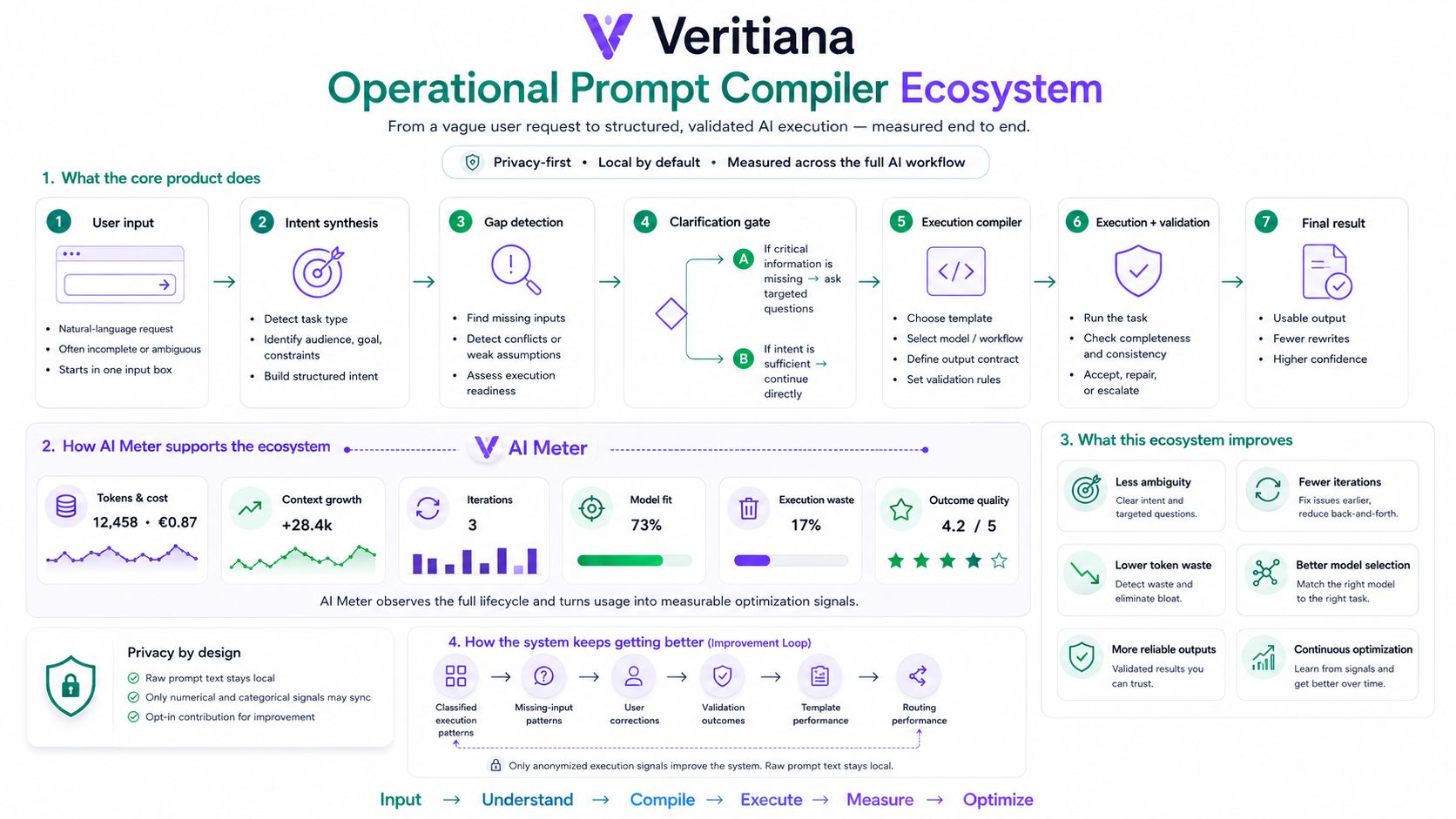
The contract defines what must be achieved, which inputs are authoritative, what constraints apply, how the task should run and how success will be validated.
OPC checks the result against the execution contract and chooses the next controlled state.
The result satisfies the output contract and success criteria.
Fix a bounded issue and rerun only the required part.
Return to the user when missing information prevents safe completion.
Require human review when automated resolution is not appropriate.
Stop when constraints, safety or evidence requirements cannot be met.
The extended flow shows clarification loops, execution preparation, model and tool routing, streaming validation, repair paths, delivery and the AI Meter metrics recorded across the system.
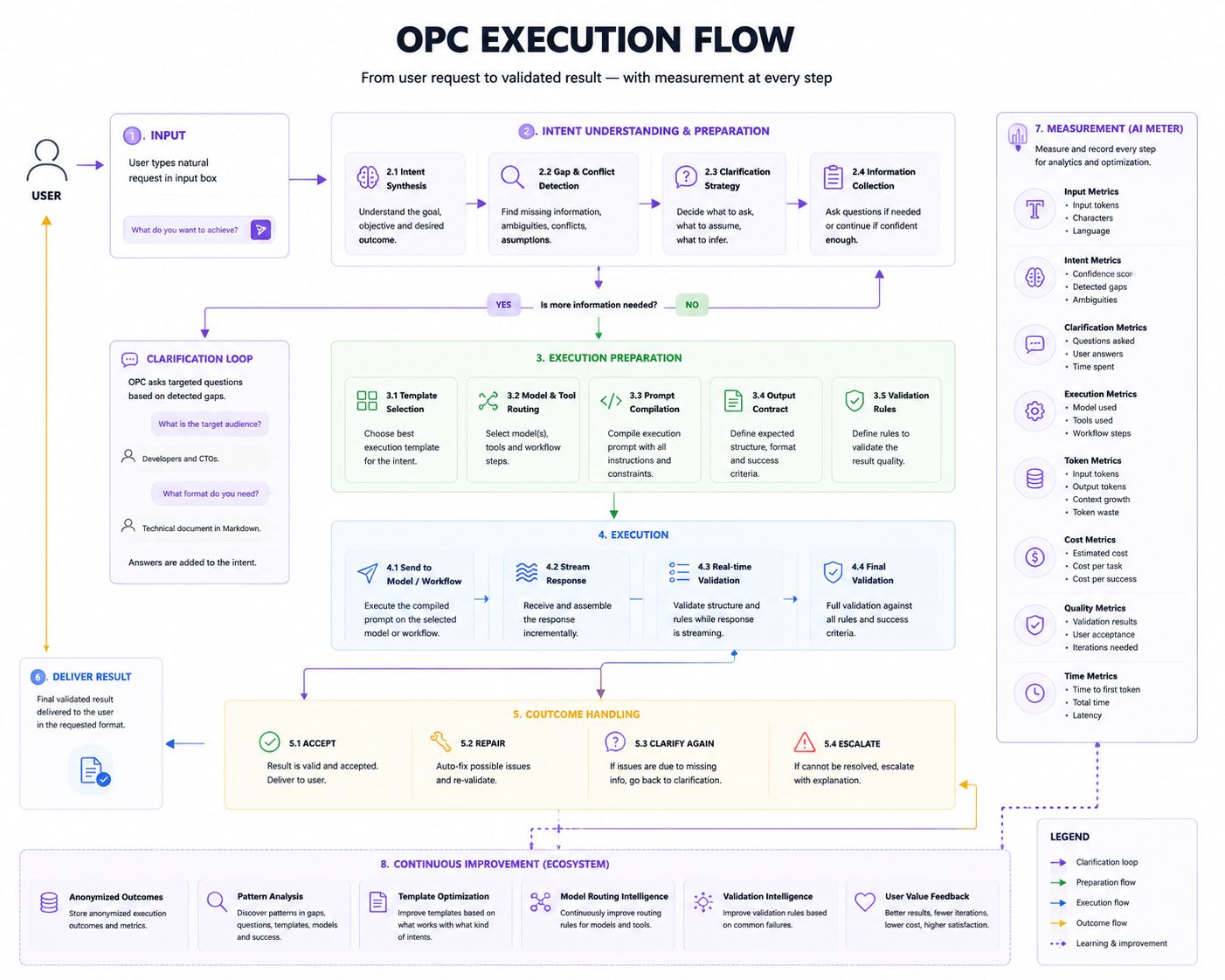
Privacy-preserving numerical and categorical events reveal where execution fails, which clarifications matter, which routes perform best and which validation rules prevent weak results.
Which fields are repeatedly absent for each intent class.
Which questions materially improve execution readiness.
Which execution contracts need fewer iterations and repairs.
Which model or workflow fits the task, cost and latency boundary.
Which checks detect failures before the result reaches the user.
Only opt-in numerical and categorical execution signals may contribute to system improvement.
OPC must prove that it reduces the difference between what the user intended and what the AI actually executed.
Reduce back-and-forth before the result becomes usable.
Detect context growth, rewrites and model calls without outcome improvement.
Measure time from initial intent to an accepted validated output.
Increase consistency, completeness and adherence to the execution contract.
One input box, a controlled execution path, measurable outcomes and a system that improves from validated signals.