01
Observe
Read the visible prompt, response, platform and displayed model label.
Veritiana separates directly observed facts, calculated estimates and interpretation. The dashboard never presents an estimate as provider billing.
Each event preserves the method, classifier and price basis used at the time of measurement, so historical records remain interpretable even when the methodology changes.
Each stage produces a distinct output. The dashboard can therefore show what was observed, what was estimated and what was inferred.
Read the visible prompt, response, platform and displayed model label.
Estimate visible input, output and accumulated context tokens.
Assign task, complexity and independent confidence values locally.
Map visible usage to a versioned API-equivalent price model.
Compare measured value, subscription price, coverage and confidence.
Veritiana estimates the text visible in the browser. It cannot see hidden system prompts, hidden reasoning, cache behavior or provider-side routing.
Estimated from the user message visible in the measured browser turn.
Estimated from the rendered AI response available to the extension.
Derived from the visible conversation trajectory available at the time of measurement.
The estimate covers browser-visible activity only and says so in the dashboard.
The classifier does not compress every interpretation into one label. Task, complexity and confidence remain separate fields.
Examples include general chat, writing, translation, summarization, research, coding, mathematics, document analysis and high-stakes work.
Complexity is estimated independently as low, medium or high. It is not inferred directly from task type.
Low-confidence results remain visibly uncertain. They are not converted into definitive claims.
Veritiana uses a compact local ONNX classifier to interpret visible AI interactions by task and complexity. Classification runs inside the browser. Raw conversation content is not uploaded for classification.
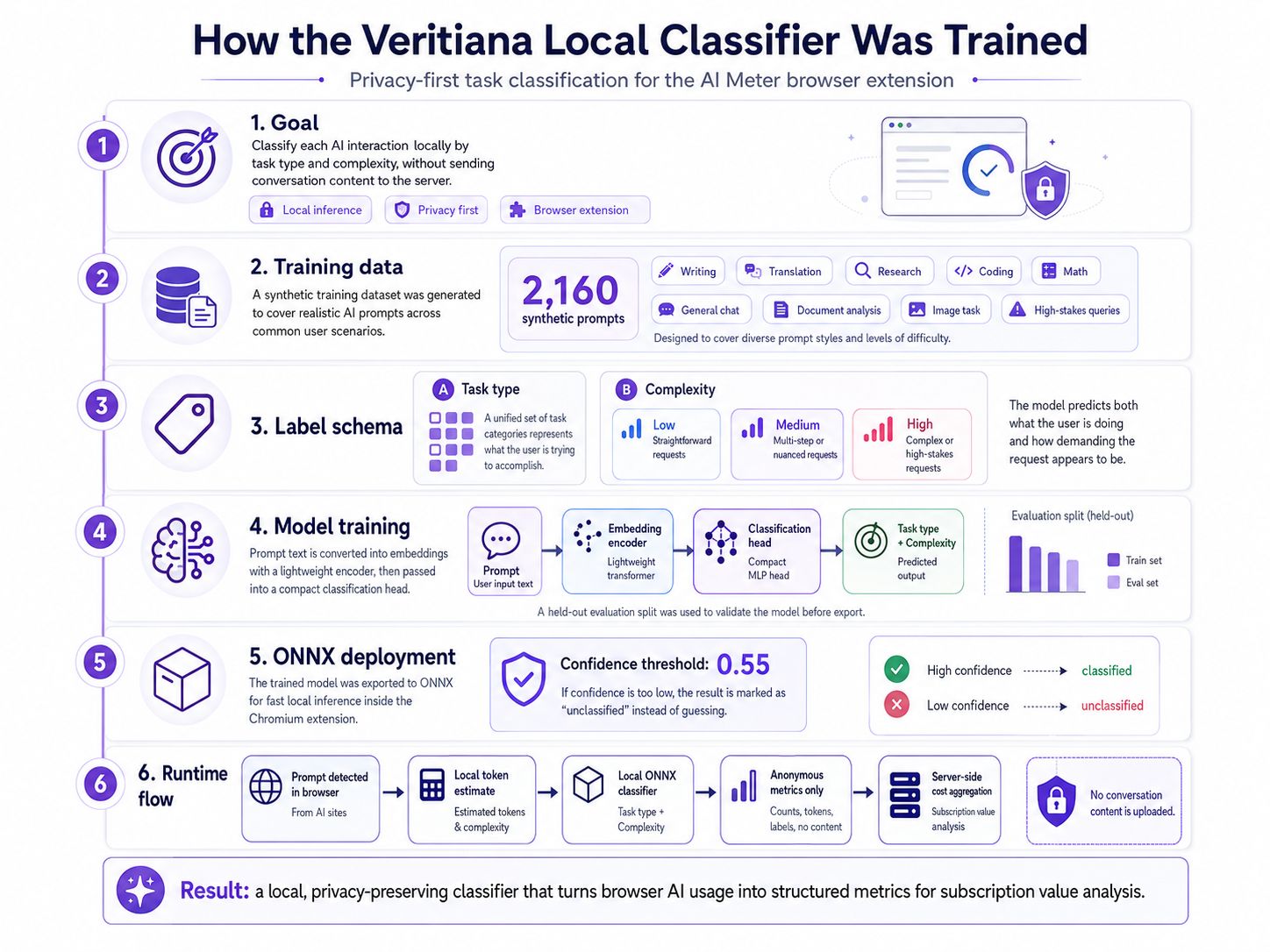
The current release was trained from normalized prompt data derived from OASST1, CoEdIT, MBPP+ and IFEval, then filtered, balanced and deterministically augmented for minority classes.
Task and complexity are predicted separately. Complexity is not inferred directly from task type.
Task is assigned at confidence ≥ 0.72. Complexity is assigned at confidence ≥ 0.66.
The estimate answers one practical question: what could similar visible usage cost through a public API pricing model?
Visible token estimates, displayed model label and the pricing version active at measurement time.
Estimated input and output quantities are mapped to versioned public price assumptions.
The result is an API-equivalent comparison value, not billing, profit, compute cost or provider margin.
A subscription comparison must include measured value, browser-only coverage and confidence. Without those limits, the verdict would be misleading.
The wording remains probabilistic because unmeasured mobile, desktop-app or unsupported usage may materially change the comparison.
The method does not infer private chain-of-thought or hidden model reasoning.
Caching, routing, batching and internal compute allocation remain unknown.
API-equivalent value does not replace official billing or subscription invoices.
Mobile and desktop applications are outside browser-extension coverage.
Ranges and confidence labels are used where a single exact number would mislead.
Pricing, classifiers and calculation rules are versioned so historical events remain interpretable.